


Ways to create space in a mix
Getting the right stereo image can be hard for a mix, and there are lots of ways to give an instrument a specific area, lets start with the most obvious. Panning can be used to direct a sound to a direction of your choosing, this is done by splitting the audio into two channels, and adjusting the volume of those two channels to give the image of direction. This is often used for recreating sounds in the direction you would normally expect to hear them, for example a live band may have the rhythm guitarist stand slightly to one side and the lead guitarist the other. To replicate this you would pan accordingly. Panning sounds throughout a song can give movement, and help catch a listeners attention. This is very common with songs in a trance or electronic genre to have multiples of sounds moving from one side of the stereo image to the other though is less common in more acoustically created genres. In this song Im creating for an animation team, the panning is set in such a way to give a full spectrum from the orchestral instruments

But panning cannot do everything on it's own. It's limited in it's ability to only direct left and right and can't give depth. Depth is often associated with frequency content. Meaning that something rich in low frequencies will be perceived as down in a mix and things rich in high frequency content will be perceived as up. This is due to the way high frequencies are lost or dampened when travelling through air. EQ-ing tracks that have lots of bass with a LP filter will further separate tracks from getting in the way of each other. What this means is that we can have various elements panned in a single direction and still have space for each of them if they are split not by panning but by frequency content. For instance I've EQ-ed the trombone towards to the high end so that it sits atop the mix but kept the lows to keep the body sounding correct.
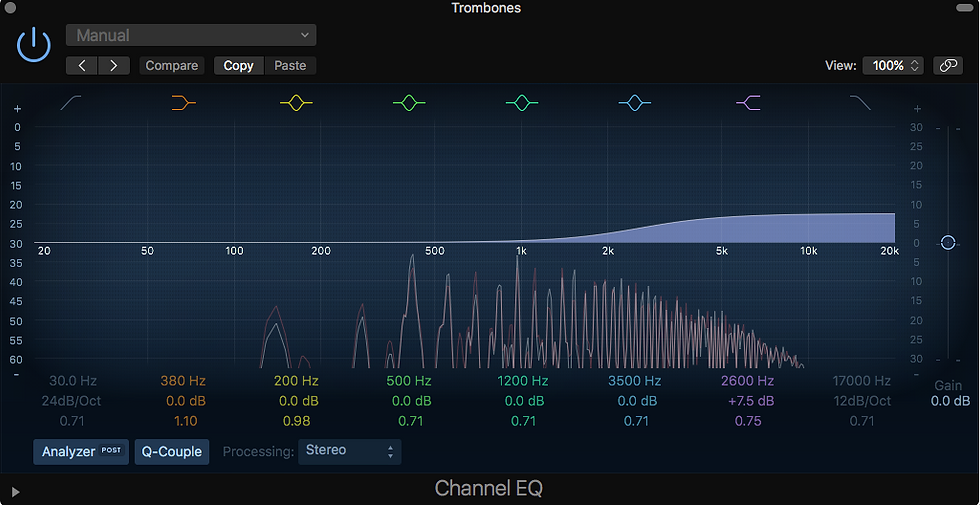
By panning and then EQ-ing there is more space between instruments available. Reverb is a great way to give a third dimension to your mix, but getting the right amount can be hard. Reverb can give instruments depth making it appear that it's further away and bouncing more reflections. Often using little amounts of reverb can give a mix a better sound than lots. I've set up my reverb in parallel like I do most things, because I feel the extra control and the type of blending it gives sounds better. I've used varying amounts of little reverb for each instrument but the main point is that it's a little amount. The reverb I've chosen is a large hall because of the style of music, being an orchestra I wanted a large reverb.

The reverb is set to have no dry signal outputting because it will be mixed in using the amount I'm sending to it.

This piece of music is not finished yet but lets listen to a version with and without all these effects. *WARNING TURN DOWN SPEAKERS* *edit - to be fixed*
These effects put on the mix give a great deal of subtle differences (apart from the dB boost) I've learned a lot by composing with these techniques, it's taught me more about composing than I'd thought. Keeping the instruments low down to only what's necessary, and making each of those instrument have their own space and finally mixing similar instruments together in the same space such as the bass. References: https://www.youtube.com/watch?v=llkiF5qxf1U http://www.soundonsound.com/techniques/creating-sense-depth-your-mix



Comments